|
Problem Set Development for School Districts If you’re a math teacher or school administrator, we hope that you’ll consider contacting us by submitting the form that’s directly below. We’re looking to work on projects with school districts to make math problem sets and then host this content on this website for ultimate use by their students. After the contact form that can be found below, we’ve included details about how a typical problem set collaboration looks and we’ve also included a section that describes five other options for a potential collaboration. Overall, we think that this is an optimal time to connect with us to discuss whether we can help your students achieve better math scores. We can also be contacted with an email to drew@mathtutorpro.com if an email is preferred over the form below. Internet-based Form for Contacting Math Tutor Pro, LLC How Problem Sets are Made & How They Help Teachers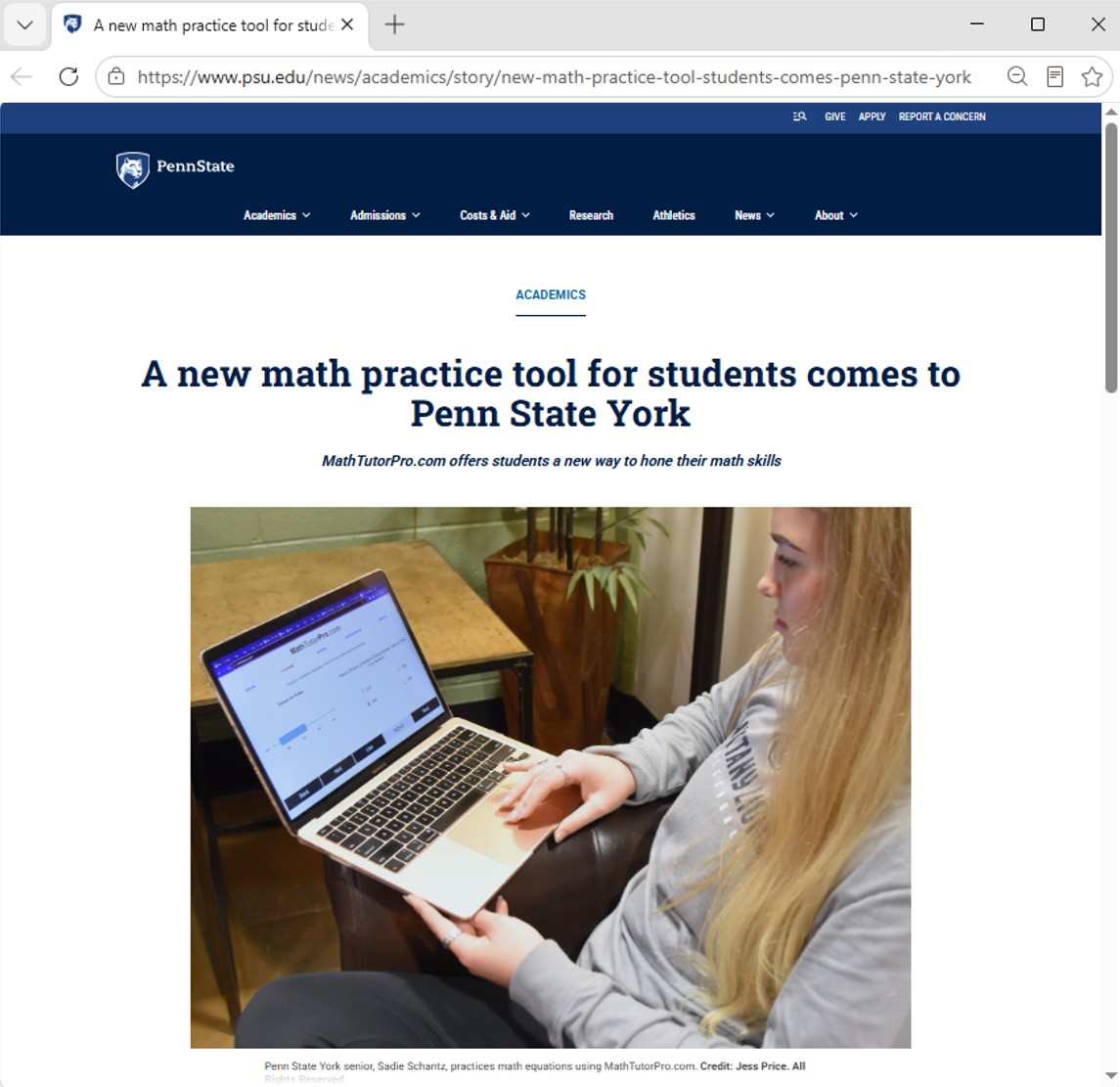
Several years ago, I worked with a Penn State York statistics professor to make problem sets for her students, and this content can be found under the Probability & Statistics Problem Set tab. I’ve since decided to use this collaboration as a case study to outline how I can best interface with schools to make math content for their students. Overall, an introductory conversation between the teacher who will be using the content in their classroom and myself is first required. We can work together to set the scope for the project in terms of number of problem sets and how to best illustrate the math concepts that are being discussed into the question & answer format that this site utilizes to help students learn. Early on in the project, we will also need to determine if a financial payment will need to be made by the host school to Math Tutor Pro, LLC in exchange for the content. In lieu of a monetary payment, it may also be possible to exchange a web-hosted news article or other resource (i.e. educational connection or to be determined). Alternatively, we are interested in finishing free trial projects that wouldn’t have a financial obligation for qualifying school districts with the goal of incentivizing schools to then purchase a larger problem set developmental project from us. Overall, all potential projects will be evaluated on a case-by-case basis, and we hope to have the opportunity to speak with a teacher or representative from your school in order to explain our EdTech capabilities. Copy this news article's url into your web browser to read about the collaboration with PSU York:https://www.psu.edu/news/academics/story/new-math-practice-tool-students-comes-penn-state-york The 10,000 Foot View of a Problem Set‐based Project with a School District After setting expectations for the 10,000 foot view of a project (i.e. content deliverables, timeline, features, etc), a draft of the problem sets will then be made. In terms of examples of new features, I added buttons to allow students to download datasets from the problem sets as CSV files for the content that I made for Penn State York. Further, the teacher(s) who will be using the content with their students will then have the opportunity to critique the content and ask for revisions. Currently, only one round of revisions will be permitted since it can become very time intensive to alter content. In terms of types of revisions that could be asked for, it can make sense to change the ranges for the numbers that are used in the problem sets. A large range could provide students with more scenarios of problems to practice, for instance.
If schools are providing a financial payment for problem sets, they will also have the ability to request how the content is hosted. As a first option, they could request that it be hosted under the normal categories so that other visitors would also be able to view the content. As a second option, they could request that it be hosted in a way that makes it more difficult to find. In other words, it wouldn’t be hosted under a category and viewing it would mean that the exact url would need to be typed into a web browser. This url could also be made difficult to find by adding additional characters. As a third option, they could request the code for the problem sets that they specifically had made for them in order for them to host it own their own servers. We would just ask that they not make changes to the content to alter it in terms of making variants or different types of problem sets using the existing ones as a framework. In this case, a school district would want to involve their own IT department if they would like to use a copy of the problem sets on their own server. This would need to be discussed with the school district when a project is negotiated in order to stay on the same page. This would give the school district additional control over how students would view and use the content for mathematics practice. 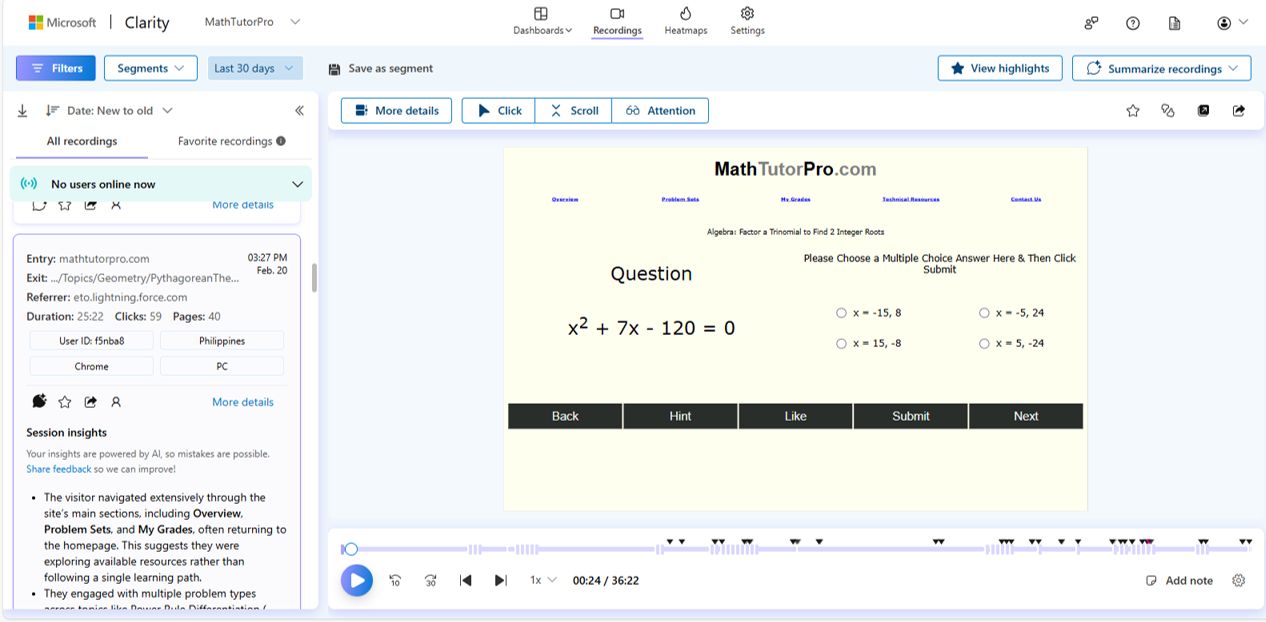 Reviewing How Students Use The Problem Sets
 In terms of reviewing how students use the content, many times, teachers will have programs to allow them to see their student’s screens during classroom use. I have the capability to view usage as can be seen from the image to the right. There are times when users and visitors clearly understand how to use the graphical user interface, but there are other times when it's apparent that the visitor doesn't understand yet how to best interact with the content. Thus, the next topic below is that other projects may be possible that could improve how the graphical user interface looks or that are more generally broader in scope. Potential for Additional Projects not Focused on the Current Type of Problem SetI would be happy to discuss any of the types of projects that are listed below with a school in the sense that these projects would be even broader in scope than making the standard problem sets. For any of these five different types of collaborations that are listed, they would all need to be evaluated on a case-by-case basis. |